We do not know whether cats think humans are cats. Studies show that cats recognize familiar people and form attachments, but they do not establish how cats classify our species. Research on recognizing an owner’s voice supports individual recognition. Using familiar cat-like greetings with people is not proof that cats mistake us for felines.
The “big cat” idea is memorable, but it combines an observation with a guess about thinking. Animalia separates those two steps so you can enjoy the relationship without relying on a myth. Our cat behavior guide explains how to use the setting when reading familiar actions.
Do cats think humans are cats or recognize us as individuals?
The research cited here shows that cats can distinguish familiar people, while leaving the species-category question unanswered. In a voice-recognition experiment, cats responded differently to their owner’s voice after hearing unfamiliar voices. That indicates recognition from sound. It does not demonstrate that a cat has a human-like concept of “person,” “cat,” or biological species.
A cat can learn that one individual is safe and another is unfamiliar without us knowing its inner labels. When your cat turns an ear toward you but does not walk over, recognition may still have occurred. A response need not look like a dog coming when called, so do not dismiss those small ear movements.
This distinction also works in the other direction, because the fact that a cat uses rubbing or kneading with you does not prove that it sees you as another cat. An action can transfer to a new social partner without showing exactly how the animal categorizes that partner.
What the experiments support, and what they leave open
Use this evidence table when you encounter a confident claim about your cat’s thoughts. The middle column stays close to what a study or observation can show. The final column identifies the extra leap, which is often where a catchy explanation outruns the evidence.
| Evidence | Supported conclusion | Extra claim to avoid |
|---|---|---|
| Different responses to owner and stranger voices | Cats can recognize a familiar human voice | The cat thinks its owner belongs to a particular species |
| A caregiver provides a secure base in an attachment test | A human relationship can matter to a cat | The cat believes the person is its biological mother |
| Some name-face associations in household research | Cats can learn about familiar individuals | Cats understand all human words or social roles |
| Rubbing against a person | Scent communication can include humans | Every rub means ownership or species confusion |
| Kneading a blanket or lap | A familiar movement occurs in a new setting | The cat cannot distinguish a person from a kitten |
| A cat returns to a chosen interaction | The current contact appears welcome | All future touching or restraint is welcome |
Animalia’s table separates evidence from interpretation; it is not a new experiment. In particular, recognizing a person, depending on that person, and classifying species are different abilities. A finding about one should not silently become proof of the others.
Why do cats use familiar social behaviors with humans?
Cats use parts of their ordinary social behavior during contact with people, including rubbing and chosen closeness. Battersea explains that rubbing deposits familiar scent on people, objects, and other cats. That gives the action a practical communication role. The same movement with different partners does not establish that the cat sees those partners as identical.
Think about what the cat does next. It might rub, move away, settle nearby, or seek a brief stroke, and those choices help you respond to the current interaction. You do not need to settle a question about species identity before you allow a cat more space.
Our guide to cat kneading explores another familiar movement without treating it as mind reading. For chosen rest close to a person, see why cats sleep on people. Both behaviors can be meaningful while their exact private explanation remains uncertain.
Do cats think we are their parents?
Caregiver attachment can resemble patterns studied in infants without proving that a cat thinks its owner is its mother. Oregon State’s attachment research concerns security and responses to separation and reunion. “Parent” can be an affectionate human description of your role, but the experiment does not establish that cats use the same family category.
You provide care, safety, and familiar company, and a cat’s dependence on those things makes the relationship important even if we never learn its internal label. Avoid testing attachment by leaving the cat distressed or changing normal care to see which family member it chooses.
Another study explored associations between familiar names and faces. Some household cats showed responses consistent with learning those links, while results varied with the setting. The human-name findings were qualified. This is evidence about learned familiarity, rather than proof that cats understand human family roles or think all companions are cats.
Use what you can observe to improve the interaction
A calm greeting does not require you to act like a giant cat, even when your cat uses a familiar rub. Cats Protection’s body-language advice recommends reading the eyes, posture, ears, and the setting together. Avoid an intense stare, leave space, and allow the cat to choose whether it approaches. Stop contact when the cat turns away or tenses.

For touch, follow our guide to petting with choice. For a quiet cat who prefers company without handling, let nearby rest be enough. You do not need to rub your face into the cat, headbutt it, or copy grooming behavior to prove that you belong in its social world.
If your cat suddenly stops choosing familiar contact or seems unwell, discuss the change with your vet. A story about “clumsy humans” should not distract from a real change in eating, movement, or behavior. A factual description of the change is more useful than a guess about what the cat thinks of you.
Frequently asked questions
Does my cat think I am a big, clumsy cat?
That phrase is an entertaining interpretation, rather than an established result from the studies cited here. Cats may use familiar social movements with people, but shared behavior does not reveal a precise mental label. Focus on how your cat responds to your actual movements, because calm approaches and a clear exit are more useful than trying to imitate another cat.
Can cats recognize human faces?
Research on familiar names and faces suggests cats can learn some associations involving individuals, although results vary and the human-family findings have limits. That is a narrower conclusion than saying a cat recognizes every person by face alone. Familiar voices and other cues can also matter. Avoid using a single response to a photograph as a home intelligence test.
Do cats understand when you talk to them?
Cats can respond to familiar vocal cues, and the owner-voice study supports distinguishing an owner from unfamiliar speakers; this does not mean a cat understands every sentence or the intention behind it. Speak calmly and keep routine cues consistent. A small ear or head movement can be a response even when the cat stays where it is.
Why do cats raise their butts when you pet them?
Rear raising during touch has several possible explanations and does not prove that the cat thinks you are its mother. Notice the whole body and pause before continuing contact. A relaxed approach differs from a tense response or an attempt to leave, and if the movement is new or accompanied by discomfort, discuss the change with your vet.
Do cats feel empathy for humans?
These studies do not establish that cats understand human feelings in the same way people do. A cat may recognize you, notice changed behavior, and choose to remain close without us knowing its exact emotional reasoning. Accept comfortable company without demanding a response. A cat that keeps its distance during a difficult day is not failing a test of affection.
What do cats think about all day?
We cannot give a reliable moment-by-moment account of a cat’s private thoughts. Observe its activity, rest, social choices, and daily needs instead of filling every gap with a human story, as a familiar routine can tell you what opportunities to provide. Changes in those ordinary patterns are worth noting and, when concerning, discussing with your veterinarian.
Value the relationship without guessing its label
Do cats think humans are cats? The evidence gives us more confidence about recognition and attachment than about species labels. Respond to the cat in front of you and let it choose contact. Animalia’s guide to cat touch preferences can help you make that daily response more comfortable. Return to our cat behavior guide for related questions.
Sources and editorial notes
- Saito and Shinozuka: recognizing owner voices
- Oregon State University: caregiver attachment
- Takagi and colleagues: familiar names and faces
- Battersea: scent communication and rubbing
- Cats Protection: body language
Animalia Editorial. Publication date: November 2, 2026. Last updated: October 30, 2026. Editorial Policy.
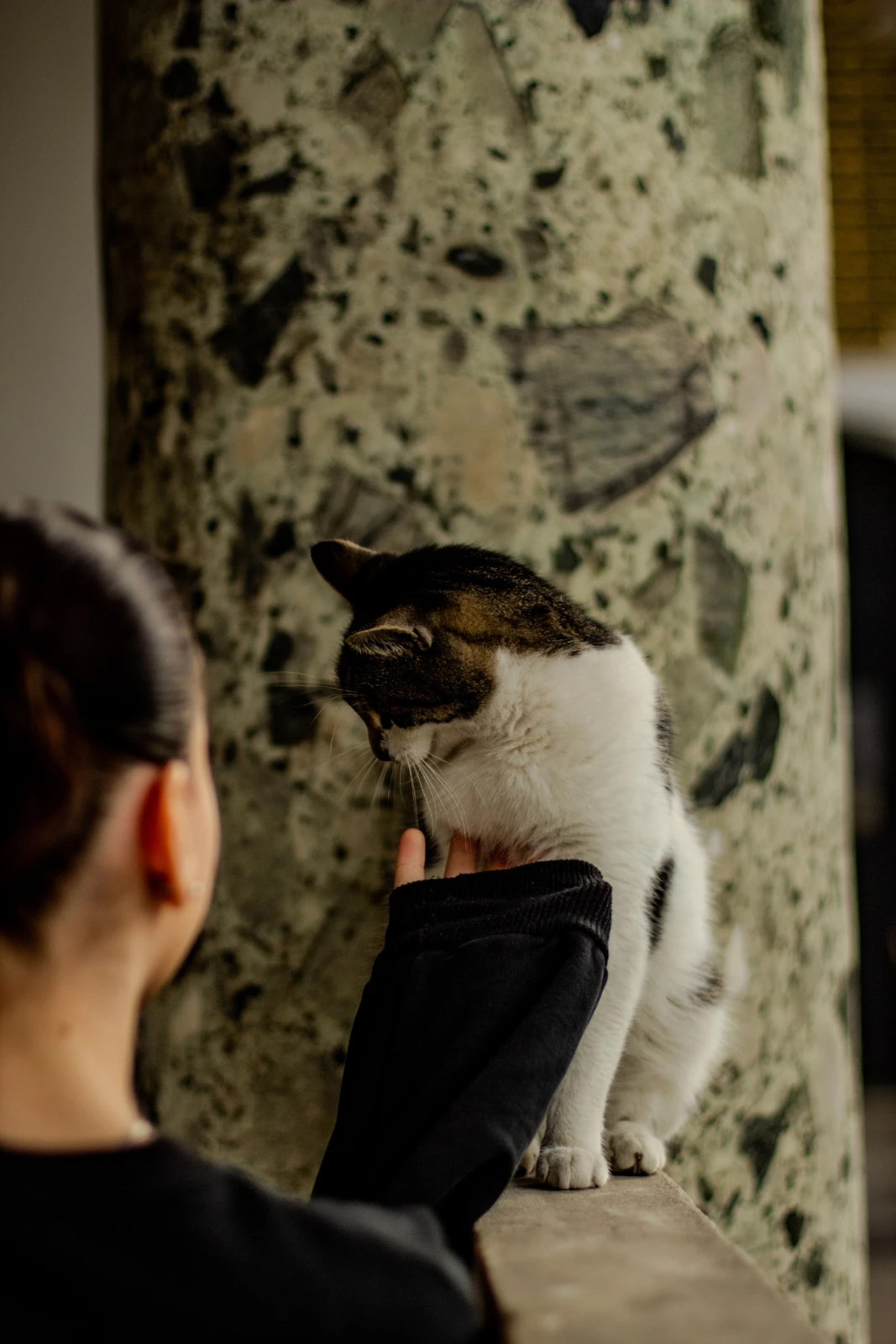
Featured photo: A cat approaches an offered hand. Allow a choice rather than reaching in or holding the head. Photo: Sami TÜRK / Pexels
Prepared with AI assistance and reviewed against the sources above.