Cats see some colors, with a narrower range than humans; blue and yellow are useful broad descriptions. Cats Protection explains that cats rely strongly on brightness and movement as well as color. A red object does not become invisible. Exact human-to-cat color charts simplify evidence and cannot show precisely what your individual cat experiences.
Animalia’s guide separates color discrimination from toy preference and eye health. Understanding the limits can improve the questions you ask without requiring a whole new set of toys. Begin with the wand-toy selection guide when the practical question is safer, more engaging play.
What colors can cats see and distinguish best?
Cats can distinguish colors, but they do not have the same broad color discrimination as humans. Cats Protection describes blue and yellow as the shades cats are thought to see best. Red-green differences are more limited. This is a description of discrimination, rather than a promise that every red item looks like one exact shade of gray.
A behavioral study published in 2016 found results supporting dichromatic color vision. Its abstract describes controlled light-discrimination tasks in two cats, not a test of favorite toy colors across household cats. The small study supports a limited color system while leaving everyday preferences as a separate question.
| Human color description | A careful broad description | What not to conclude |
|---|---|---|
| Blue and yellow | Useful broad labels for the range commonly described in welfare guidance. | Every blue or yellow product will be preferred. |
| Red and green | Differences between these hues may be harder to distinguish. | A red ball cannot be located or used. |
| Pink, orange, or purple | Human color names do not provide a precise feline-view conversion. | A digital swatch shows the exact subjective shade. |
| White, black, and background brightness | Visibility also depends on the surrounding scene. | Color alone explains every response to a toy. |
The table summarizes practical limits, not a measured palette for every surface and light source. Animalia avoids a strict list saying one named color always becomes another. Your cat can use brightness, shape, motion, and other information even when hue differences are limited.
Why do color charts and explanations differ?
Studies can measure responses to controlled light, but a human color chart also adds assumptions about a cat’s experience. The 2016 study explains how earlier findings and brightness cues complicated interpretation. Treat a feline-view illustration as an approximation, and prefer sources that describe what was measured rather than presenting exact subjective colors as settled facts.
A 2013 research paper describes neural signals consistent with a blue-yellow color system. The researchers recorded responses to controlled visual stimuli. That is evidence about how signals travel through the visual system, rather than a photograph taken through a cat’s eyes or a shopping trial comparing colored toys.
Cats Protection distinguishes cones, which support color detection, from rods used in low light. These functions help explain why color range and dim-light ability are different questions. An eye adapted to use limited light does not need to distinguish the full human palette to function well.
Some general advice pages disagree about cone counts or give different color labels. Here, the original research supports a limited system without claiming a perfect conversion for every hue. We do not reproduce a human photograph with a filter and call it a verified view from your cat’s perspective.
Choose play by visibility, movement, and your cat’s response
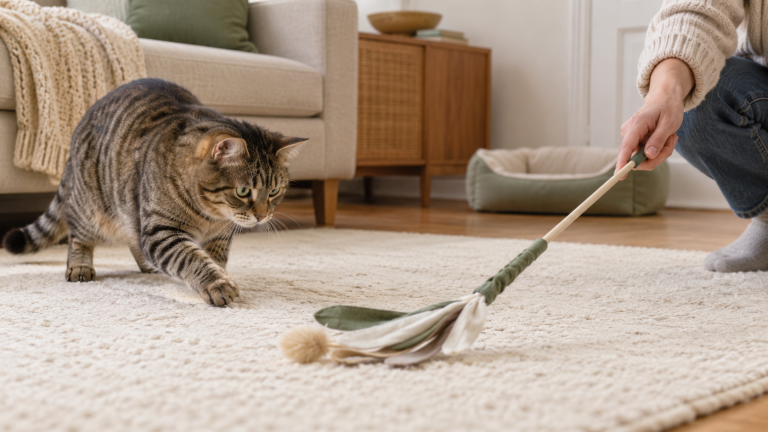
Cats Protection emphasizes brightness and movement alongside color. A practical starting point is a suitable toy that stands out from its background, presented at a comfortable distance. Blue or yellow can be options, but there is no need to discard a safe toy your cat already enjoys because it looks red to you.
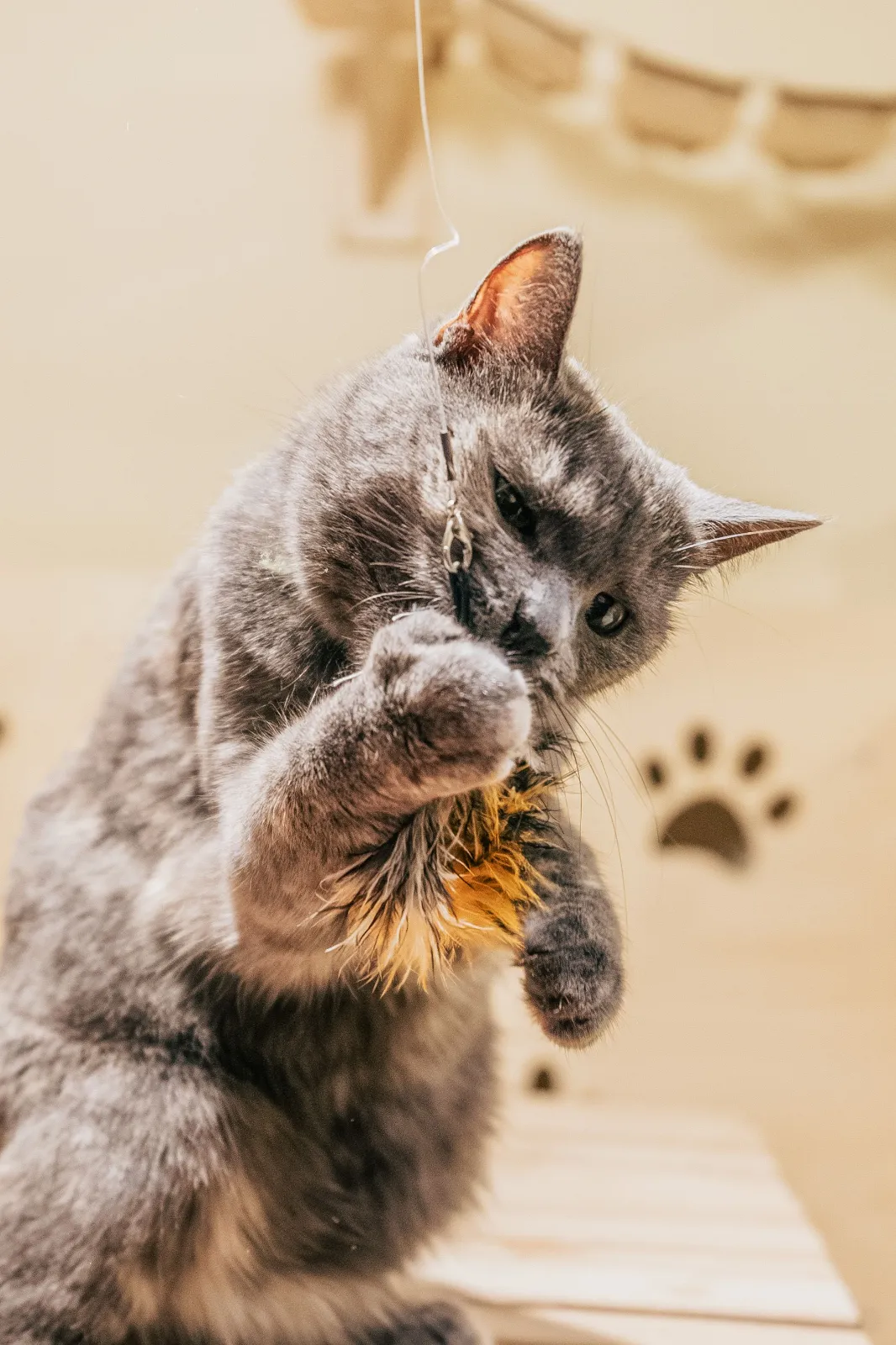
Animalia suggests changing one ordinary feature at a time while keeping play voluntary. If your cat loses the toy against a patterned rug, try a clearer background before buying another color. If a stationary toy draws little interest, try appropriate movement without poking it into the cat’s face.
| What you notice | A practical adjustment | Keep the interpretation limited |
|---|---|---|
| The toy blends into a busy rug | Try a less cluttered background. | An improved response does not identify the exact color seen. |
| The cat follows movement but ignores the still toy | Vary the movement when the cat wants to play. | Stillness and color are different features. |
| A familiar red toy remains popular | Keep using it if it is safe and suitable. | Limited hue discrimination does not mean invisibility. |
| Play interest drops along with other changes | Discuss the wider change with your vet. | A color mismatch is not a health assessment. |
The RSPCA recommends suitable play, toys, and opportunities to express normal activity. Use the daily play routine and toy rotation plan to organize choices. For string-toy setup and storage, follow the linked wand-toy guide and supervise play.
Keep color questions separate from vision problems
Cornell recommends reporting signs of a vision problem to your vet without delay. New difficulty navigating, changed eye appearance, or discomfort deserves assessment rather than a color experiment. A cat ignoring a toy does not by itself prove sight loss, and a successful chase does not replace an eye examination.
Describe the change in ordinary life: which familiar object was difficult to find, whether the lighting changed, and what else you noticed. Avoid moving furniture into the route or shining bright lights into the eyes to test a theory. Your vet can assess the eyes and recommend any appropriate home changes.
For everyday care, use the home resource layout guide to keep familiar routes easy to use. You can improve access without deciding which named shade your cat sees. Comfortable rest and safe movement remain relevant whether a favorite bowl is blue, red, or patterned.
Your next step is to watch an ordinary play session and adjust one practical feature if needed. Animalia’s cat behavior hub covers related observations. Let color knowledge guide a sensible option, while your cat’s comfort, safe equipment, and changes in normal behavior guide the care decision.
Frequently asked questions
Can cats see in color?
They do not see only black and white. Cats have a more limited color-discrimination system than humans, commonly described in relation to blue and yellow and difficulty with red-green differences. The phrase color blind can be misleading without that explanation. It does not mean that objects of certain human-named colors disappear or that a cat cannot play with them.
Can my cat see a red toy?
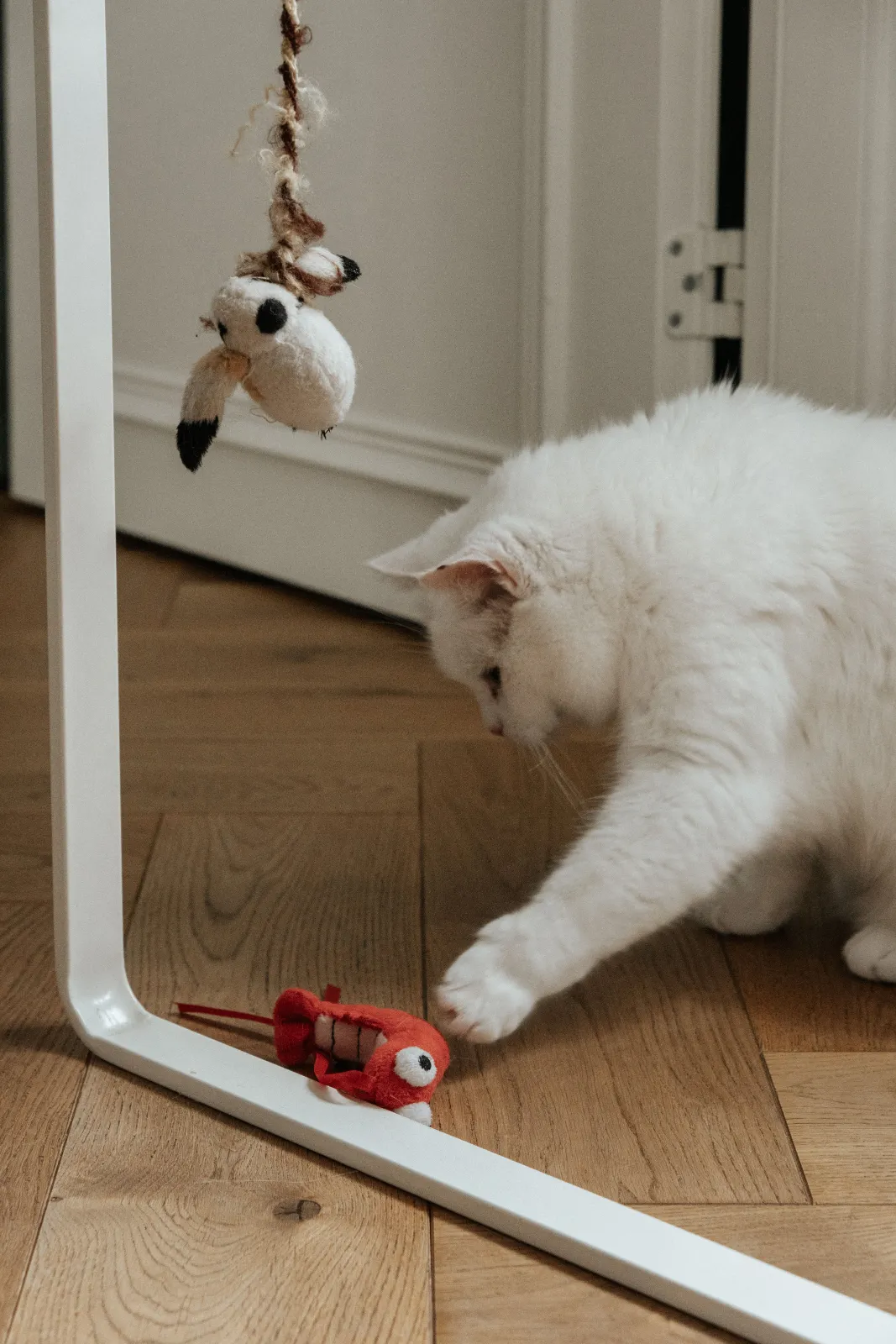
A red toy remains an object with brightness, shape, texture, scent, and possibly movement, even when its hue is not distinguished as you distinguish red. A cat can therefore locate and enjoy it. If the toy is safe and your cat likes it, there is no reason to replace it solely because an online chart says cats cannot see red.
Do cats prefer blue and yellow toys?
Those colors can be useful options, but the color system does not establish a universal favorite. Background, movement, texture, scent, previous experience, and whether the cat wants to play also matter. Offer suitable choices and notice the response without forcing a comparison. A cat choosing one toy does not prove that its color was the deciding feature.
Do cats see color exactly as a simulation shows?
An app can create an illustration based on assumptions about feline vision, but it cannot verify your cat’s exact visual experience. Screen settings, lighting, brightness, and the model used affect the result. Treat filtered images as explanations with limits, not photographs from a cat’s viewpoint or tools for diagnosing an eye problem or choosing every household item.
Does ignoring a colorful toy mean my cat has poor vision?
No, a single response to a toy cannot assess vision. Your cat may not want to play, or the movement, background, or toy itself may be uninteresting. Look for a change in normal navigation, eye appearance, comfort, or wider behavior. Discuss concerns with your vet instead of repeatedly testing the cat with brighter lights or different colors.
Sources and editorial notes
- Cats Protection: color vision: limited color range, broad blue-yellow description, and brightness/movement
- Clark and Clark, 2016: color-discrimination study: original research abstract; two-cat controlled task, interpreted with limits
- Buzás and colleagues, 2013: color-opponent neurons: original research; abstract, introduction, methods context, and discussion consulted
- Cornell Feline Health Center: vision problems: timely assessment of eye or vision concerns
- RSPCA: cat behavior: appropriate play and access to normal activities
Animalia Editorial. Publish date: October 31, 2026. Last updated and sources checked: October 29, 2026. The practical tables are original editorial aids, not experimental findings. Toy-color preferences and exact subjective feline colors are not claimed to have been established. See the editorial policy.
Featured photo: A ginger cat holds a colorful toy ball; the photograph shows human-visible colors, not a simulation of cat vision. Photo: Lance Zhang / Pexels.
Prepared with AI assistance and reviewed against the sources above.