Why do cats bury their poop? Covering waste is a natural toileting behavior, but its purpose is not completely settled. Cats Protection emphasizes concealment, while BC SPCA discusses hygiene and communication. Neither explanation establishes why your individual cat covers a particular stool. Keep the litter box usable and ask your veterinarian about concerning changes.
Burying does not mean a cat understands human embarrassment, and uncovered poop does not prove defiance. Animalia’s guide separates possible explanations from practical care: suitable access, comfortable toileting, observation of change, and a calm response that avoids forcing the cat to dig.
Is there one proven reason for burying poop?
The behavior has several proposed explanations, and reputable sources emphasize different ones. Concealing location, maintaining a home area, and scent communication all feature in those discussions. Treat them as background explanations rather than a way to identify one cat’s motive. An individual litter-box observation cannot establish an evolutionary purpose or a social ranking.
Cats Protection’s historical explanation focuses on avoiding detection by predators and prey. BC SPCA explicitly notes scientific uncertainty, then discusses cleanliness near home and communication away from home. Those are different accounts. You do not need to choose one as a complete explanation before making the litter area comfortable and seeking advice about a change.
Avoid turning the behavior into a claim that your cat sees you as a dominant animal, is ashamed, or is deliberately insulting another cat. Those interpretations do not tell you whether the box is usable or toileting is comfortable. Keep the practical question separate from an appealing story about what the cat must be thinking.
Compare the observation with the next care question
Use this Animalia table to organize what you saw without assigning a cause. It is a household review, not a diagnosis or an instruction to wait for more evidence. When the cat seems uncomfortable or the behavior changes suddenly, contact your veterinarian rather than using the table to rule out a problem.
| Observation | Care question | Avoid concluding |
|---|---|---|
| Usually covers stool and appears comfortable | Is the usual litter setup still available? | The behavior proves one emotion or motive |
| Leaves a stool uncovered | Is this usual, or a change with other signs? | The cat is defiant or asserting rank |
| Scratches the wall or box edge | Can the cat turn and dig comfortably in suitable litter? | More scratching necessarily means better hygiene |
| Leaves quickly when another animal approaches | Are access and exits comfortable? | The cat simply needs more training |
| Strains or repeatedly attempts to toilet | Does the cat need urgent veterinary advice? | This is only a burying problem |
A useful record might say “scratched the wall after using the box; this is new” rather than “forgot how to bury.” Note what changed in access, litter, cleaning, or the surrounding room. Keep those details as context, without assuming that one recent change explains the whole pattern or removes the need for assessment.
Do not place the cat back in the box to repeat the action for a video. If a photograph of the setup helps, take it while the cat is elsewhere and preserve their access. You can ask the veterinary team what further observations are useful rather than creating a second uncomfortable experience to make the record complete.
How can you make digging and toileting comfortable?
Provide an accessible, suitably sized litter box with familiar appropriate litter, regular cleaning, and a quiet location where the cat can leave freely. Cats Protection recommends reviewing the whole toileting setup. Keep it separate from food and water, and avoid restraining the cat or moving their paws to demonstrate covering.
Our litter-box location guide covers the room-planning task, while the cleaning guide helps you maintain ordinary care. A burying habit does not replace cleaning by a caregiver. Check the condition of the box rather than assuming covered waste is no longer part of the task.
In homes with several animals, review actual routes and separate access. Our multi-cat resource guide explains that arrangement. A box can be physically present but difficult to reach without passing another cat or a busy doorway. Adding more litter to the same guarded location does not resolve that access question by itself.
Changes, uncovered stool, and force-free care
Whether a cat covers every stool is less useful than whether the pattern has changed and toileting appears comfortable. Avoid imposing a performance goal such as digging for a fixed time or producing a particular depth of cover. A cat does not need to complete a ritual to earn food, attention, or the chance to leave.
If you want to change the setup, make the purpose clear and avoid several abrupt experiments at once. Keep suitable toilet access available while you discuss preferences or difficulties with the veterinary team. Do not hold a cat in a new box, push their paws through litter, or punish them for leaving waste visible.
Animalia recommends a simple handover for caregivers: the usual setup, cleaning responsibilities, the change to watch for, and who to call. Our household care log can hold that information. It is a way to coordinate care, rather than make one person enforce a new digging routine while another keeps the old arrangement.
When should you contact a veterinarian about toileting?
Ask your veterinarian about sudden changes, apparent discomfort, blood, or other concerning toileting signs. If your cat repeatedly tries to pee but passes little or nothing, contact a clinic immediately, as PDSA advises. Do not assume straining is simply constipation or incomplete burying, and do not delay help to finish a behavior record.
Describe what you saw and any uncertainty about urine versus stool. Keep ordinary care accessible while following the clinic’s instructions, and avoid home remedies or attempts to press the abdomen. The cause needs appropriate assessment; improving litter placement is a separate task and should not become a reason to postpone the call.
Start with one practical action: maintain the usual comfortable setup, clean the box, or request professional advice about a change. Return to the cat behavior hub for related questions. A useful explanation of burying supports care without requiring you to know the cat’s exact motive or force the behavior to look tidy.
Frequently asked questions
Is uncovered poop proof that my cat is dominant?
No. A single litter-box observation does not establish a social ranking or explain the whole behavior. Before assigning a cause, notice whether the pattern is usual, whether the box is comfortable and accessible, and whether other signs have changed. Seek veterinary advice about concerns rather than punishing the cat or treating the stool as a message about your place in the household.
Should I move my cat’s paws through litter to teach covering?
Avoid forcing the movement or keeping the cat in the box to complete a demonstration. Review suitable litter, space, cleaning, and comfortable access instead. If a kitten or cat struggles with toileting, ask your veterinary team for individual guidance. Ordinary toilet access should remain available without requiring the cat to tolerate restraint or perform a particular digging pattern.
Does buried poop mean I can leave the box uncleaned?
No. Covering does not replace a caregiver’s regular cleaning routine or a check that the box remains usable. Follow suitable cleaning guidance for the litter and equipment, and observe changes without disturbing the cat during toileting. If several people share care, make the cleaning responsibility clear so covered waste does not lead everyone to assume someone else has removed it.
Why does my cat scratch the wall instead of covering stool?
Record the action and review whether the cat can turn, dig, and leave comfortably in the current setup. The movement alone does not establish frustration, a diagnosis, or a particular message. Ask for advice if it is new or accompanies other changes. Avoid repeatedly returning the cat to the tray or forcing their paws toward the litter.
Should I wait if my cat is straining in the box?
Contact your veterinarian promptly and describe whether you saw urine or stool, including any uncertainty. Repeated attempts to pee with little or no output require immediate attention. Do not classify the event as a burying problem, assume the cat is constipated, or wait for a more complete record before calling. Follow the clinic’s instructions for the current concern.
Sources and editorial notes
Animalia Editorial. Reviewed November 4, 2026. Sources differ on the purpose of covering waste; no single evolutionary account is treated as an individual diagnosis. The comparison table is a care-planning aid. See our editorial policy.
Cats Protection: concealment explanation; BC SPCA: uncertainty, hygiene and communication; Cats Protection: toileting setup and changes; PDSA: urgent urinary signs.
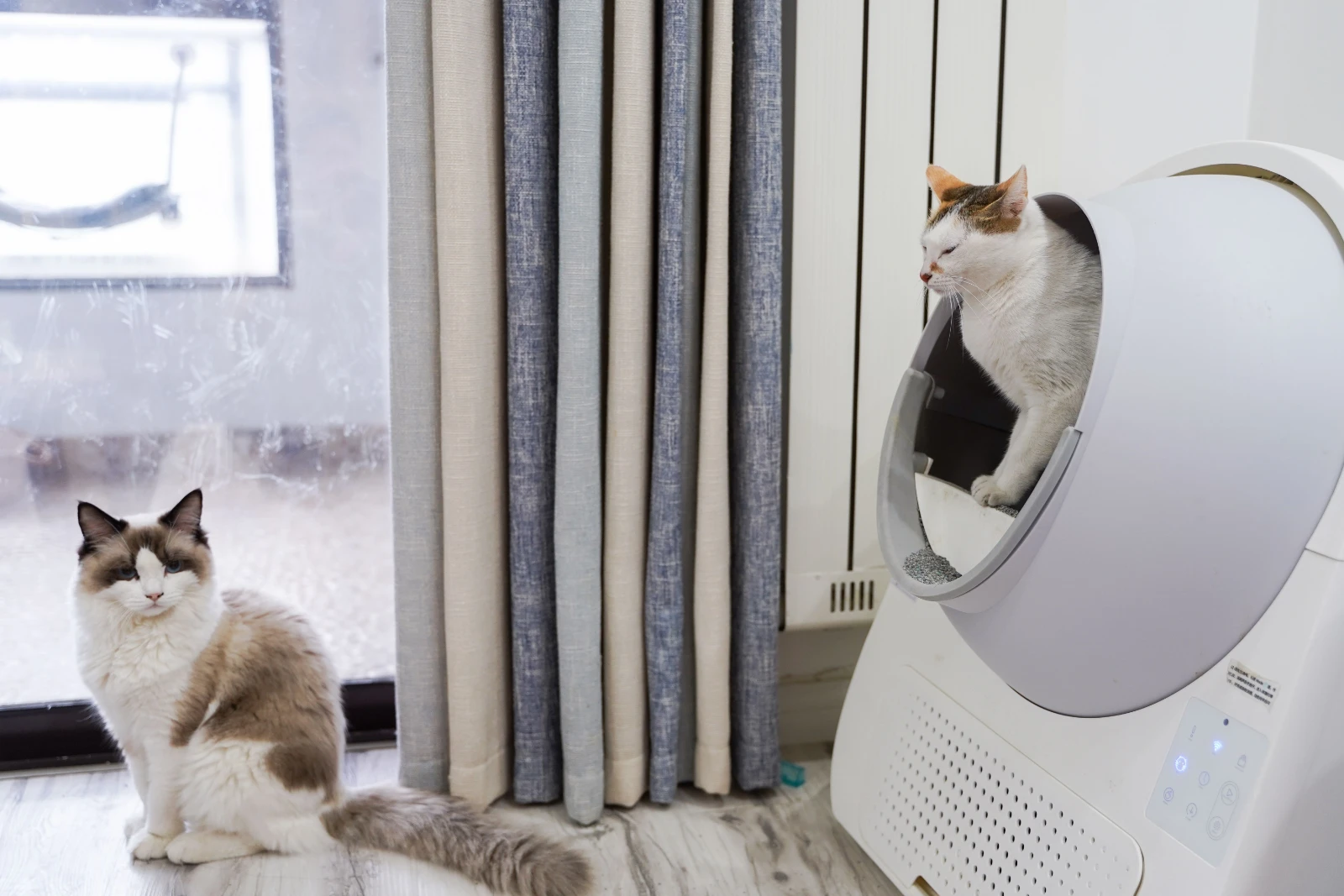
Featured photo: Two cats are near an automatic litter box. This photograph does not show whether either cat buried waste. Photo: Nicholas Fu / Pexels.
Prepared with AI assistance and reviewed against the sources above.