Cats do not kiss in the human sense, so we cannot assume they understand kisses as a declaration of love. Cats Protection advises letting the cat approach and respecting familiar contact limits. Some accept a brief kiss from a trusted person; others prefer distance. Their response matters more than your intention.
You can show affection without putting your face close to a cat’s mouth or holding it still. Animalia explains how to separate chosen contact from tolerance, notice early stop signals, and offer quieter alternatives. Our cat behavior guide provides the broader context for those decisions.
Do cats understand kisses or learn to accept the contact?
The evidence here supports being cautious about the meaning of a kiss. Cats can recognize familiar people and form close relationships, but that does not prove they translate lip contact into a human message. Cats Protection notes that an unfamiliar kiss can invade a cat’s personal space. Familiarity and individual preference therefore matter.
A cat may find the person, routine, and gentle handling familiar without sharing your idea of the gesture. You do not have to settle that private interpretation before making a good choice: if the cat turns away or tenses, stop, because a tolerated gesture is not something you need to repeat.
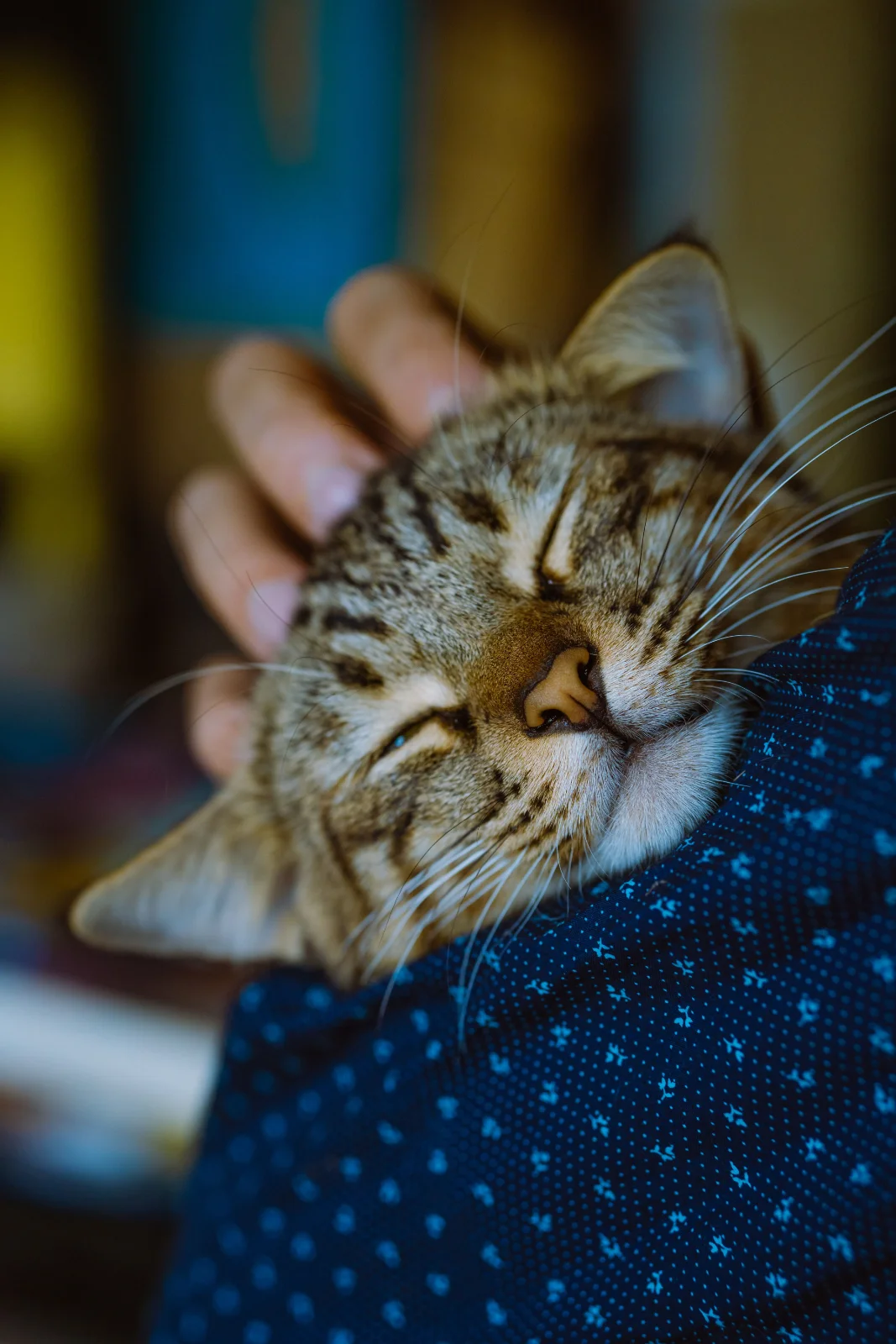
Likewise, a cat rubbing its head against you is not a request for your lips to follow. Battersea describes rubbing as scent communication. Receive the rub calmly, let the cat move, and avoid turning a voluntary approach into face holding or a tight cuddle.
Read the pause before deciding whether to continue
Animalia’s pause guide focuses on what the cat chooses before and after you move. It does not assign an exact emotion to a still face, so when signals conflict, the useful response is to lower pressure rather than repeat a kiss to see what happens.
| What you observe | What remains uncertain | A lower-pressure choice |
|---|---|---|
| The cat approaches you freely | Which kind of contact it wants | Wait and offer a familiar brief touch. |
| The cat stays nearby without leaning in | Whether touch is wanted at all | Enjoy quiet company without advancing your face. |
| The cat rubs and then steps away | Whether it wants another interaction | Allow the departure and leave the route clear. |
| The body becomes still and tense | Whether the cat is merely tolerating contact | Stop and give space. |
| The head turns away or ears flatten | Which precise emotion is involved | End the approach before a swipe or bite. |
| The cat returns after a pause | Whether the same gesture is welcome again | Let the cat initiate; do not assume a kiss is required. |
Look at the whole body rather than one sound. Cats Protection explains that purring can occur with stress or pain as well as contentment. A purr is not a reason to ignore turning away, tension, or attempts to leave.
How can you show affection without kissing your cat?
Offer calm company, chosen play, or brief gentle touch in a place your cat normally enjoys. Cats Protection recommends a soft slow blink instead of an intense stare. Let the cat approach and pause before adding more contact. You can support a close relationship while keeping both faces comfortably apart and allowing an easy exit.

Slow blinking has experimental support as positive social communication. The researchers observed eye movements and approach behavior; they did not establish that a blink literally means a kiss or a sentence about love. Use it as a gentle invitation, rather than a performance your cat has to return.
Our guide to petting a cat with choice gives practical pauses for familiar touch. For a cat who prefers activity, use a chosen play routine. Neither option requires restraint, a close face, or persuading the cat to endure something it dislikes.
Does your cat like kisses if it sits still?
Stillness alone does not tell you that a kiss is welcome. Read posture, ears, movement, and the cat’s opportunity to leave together. Cats Protection’s body-language guidance describes tense and anxious patterns as well as relaxed ones. If you cannot tell, pause and create space. There is no need to keep testing the gesture.
Watch the approach as well as the moment of contact, because if you block the route with your arms, hold the head, or lean over a resting cat, it has less freedom to show a preference. Remove that pressure before asking what the lack of movement means.
A cat that chooses a cheek rub may still dislike kisses, and preferences can vary by person or day, as our guide to cat touch preferences explains why enjoyable contact depends on the individual. For early mouth-contact warnings, read cat nipping and contact limits and stop before the interaction escalates.
Keep hygiene and sudden changes in view
Cats Protection advises against kissing a cat on the lips and recommends avoiding kisses when either the cat or person is unwell. It also warns against surprising a cat with unfamiliar close contact. The simpler alternative is to keep your face out of the interaction and offer a gentle hand or quiet company instead.
If your cat suddenly avoids familiar touch, seems sore, or changes eating, grooming, or activity, contact your vet. Do not decide it has stopped caring about you, and do not hold its head to inspect the reaction. Describe what changed and ask the clinic what assessment is appropriate.
Attachment is broader than one greeting. Oregon State’s caregiver-attachment study supports taking the human-cat bond seriously, but it does not require kisses or show that more physical contact means a stronger bond. Animalia’s practical priority is comfortable daily care that leaves the cat a real choice.
Frequently asked questions
Do cats feel love when you kiss them?
We cannot know a cat’s exact emotional experience from a kiss. A familiar person’s gentle contact may be accepted, but acceptance does not prove the cat translates it as human love. Observe whether the cat chooses contact and remains comfortable. If it turns away or prefers to leave, respect that response without treating it as a rejection of you.
Do cats like kisses on the head?
Some cats accept brief familiar contact near the head, while others dislike a face approaching at all. Let the individual cat guide you instead of relying on a universal kissing spot, and do not hold the head still or follow the cat when it moves away. A gentle hand stroke or quiet company can serve the same affectionate intention.
Do cats kiss each other?
Cats do not kiss each other in the human lip-to-lip sense. They can use nose contact, rubbing, and other social behavior during friendly encounters. Those actions do not oblige a person to copy them. Allow your cat to choose an approach, and avoid putting your lips near its mouth or using the greeting as permission for restraint.
Do cats know we love them without kisses?
Kisses are not required for dependable care or a close relationship, as cats can experience familiar company, play, comfortable rest, and brief chosen touch without our proving that they understand the word “love.” Keep daily needs predictable and respect personal space. An interaction that ends calmly can be valuable even when it includes no cuddle or face contact.
Do cats care if you cry?
The attachment and slow-blink studies do not establish how cats interpret human tears. Your cat might approach, remain nearby, or keep its distance when your behavior changes. None of those responses is a fair home test of empathy. Accept comfortable company if it is offered, keep care routines manageable, and avoid pulling the cat close for reassurance.
How do I tell my cat I love her?
Show it through care and interactions she can choose: sit nearby, offer a familiar game, or pause during a gentle stroke to see whether she wants more. A soft blink can provide friendly contact at a distance. Respecting a wish to leave is part of that approach, rather than a sign that the interaction has failed.
Choose affection your cat can freely accept
Do cats understand kisses? Treat the meaning as uncertain and the cat’s comfort as observable. Let an approach stay voluntary, stop early, and offer another way to spend time together. Animalia’s guide to understanding your cat connects those choices with the rest of daily behavior.
Sources and editorial notes
- Cats Protection: kissing and contact boundaries
- Cats Protection: whole-body signals
- Battersea: scent communication
- Humphrey and colleagues: slow-blink research
- Oregon State University: caregiver attachment
Animalia Editorial. Publication date: November 2, 2026. Last updated: October 30, 2026. Editorial Policy.
Featured photo: A cat rests on a woman’s lap. Quiet company can be an alternative to close face contact. Photo: Jonathan Borba / Pexels
Prepared with AI assistance and reviewed against the sources above.