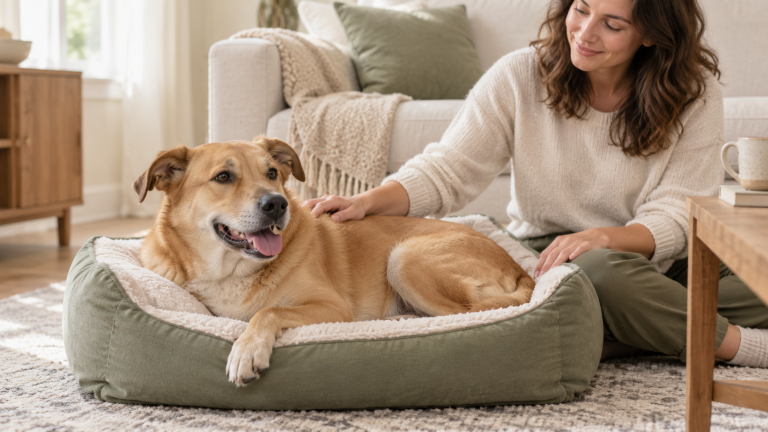
In a multi-dog home, start enrichment with individual comfortable spaces instead of assuming every dog should share an activity. Separate food, toys, and attention when appropriate, and plan how to put equipment away. The useful question is what each dog enjoys comfortably.
List each dog’s preferences
Write down activities, equipment, and locations that already suit each dog. One may enjoy a gentle search while another prefers time beside a caregiver. They do not need matching games or identical schedules.
Include any instructions from your veterinary or behavior team. Where guarding or conflict is a concern, ask for an individualized plan rather than testing whether an activity is safe together.
Prepare separate comfortable areas
Use familiar rooms or suitable barriers according to the household’s established management. Ensure each dog has an appropriate arrangement and is comfortable with the separation.
- No shared access to the current food or toy.
- Enough space for the activity.
- A caregiver who can monitor participation.
- A plan for stopping and clearing the area.
A barrier is a management tool, not proof that a distressed dog will settle behind it.
Run one manageable activity
Start with a known easy option. Use our beginner puzzle checklist where appropriate, or choose a non-food alternative.
Keep the session responsive to the individual dog. Do not extend one dog’s activity simply so both finish at the same time.
Clear resources before changing access
Put away food containers, leftover pieces, and current toys before returning to the usual household arrangement. Check the floor and furniture rather than assuming the dog found everything.
Explain this reset to everyone who helps. A resource left behind can change an otherwise ordinary shared space.
Keep records individual
Record what each dog chose and any difficulty with the arrangement. Review the layout if one dog consistently waits, withdraws, or becomes uncomfortable.
Seek appropriate professional help for conflict, guarding, or sudden behavioral changes. More exciting enrichment is not a substitute for assessing those concerns.
Sources and editorial notes
General activity context: Dogs Trust: enrichment activities. Separate-session organization is an editorial management framework, not a household compatibility assessment.
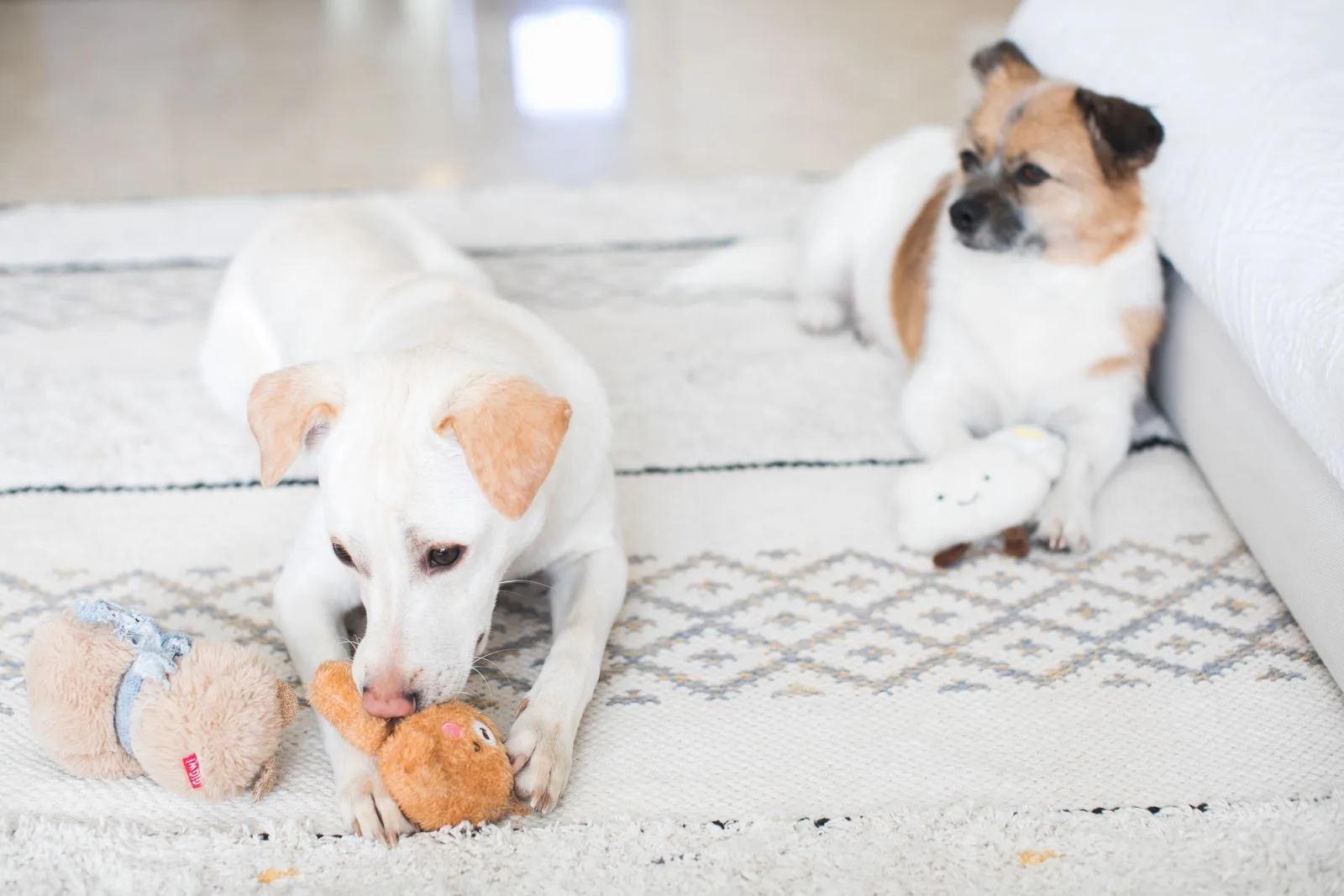
Featured image: Two dogs settled a short distance apart on a rug, each with its own toy. Photo: qiana zhang / Pexels